


حل نمونه سوال تصویری آیلتس: توصیف یک عکس به کمک chatGPT
قصد داریم برای حل سوالات زبان (یا هر مسئلهای به زبان انگلیسی) از هوش مصنوعی (مانند chatGPT) استفاده کنیم.
فرض کنید دارید یک کتاب نمونه سوالات انگلیسی (مانند IELTS) را ورق میزنید. به این صفحه میرسید:
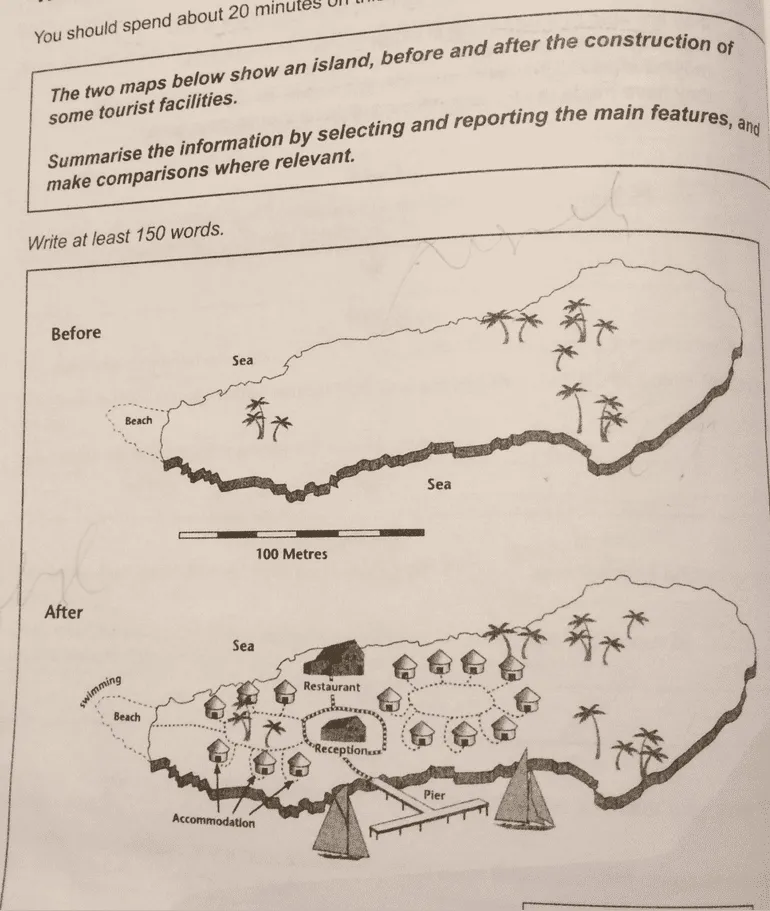
– دقیقاً چه سوالی پرسیده شده؟
– چگونه باید آن را انجام دهیم؟ (نوشتن 150 کلمه درباره این دو نقشه)
– چگونه ایرادات متنی که نوشتهام را متوجه شوم؟
– و بسیاری موارد دیگر
تا قبل از آمدن سرویسهایی مانند chatGPT برای انجام این موارد، به یک معلم خصوصی نیاز داشتیم. اما الان chatGPT میتواند مانند یک معلم فوق العاده، مشکل ما را حل کند.
فقط کافیست با گوشی، از این صفحه از کتاب عکس بگیریم، عکس را به chatGPT بدهیم و از او به روش خاصی که خواهیم گفت، سوالات بالا را بپرسیم.
chatGPT نوشتههای عکس را میخواند، تصویر نقشه را متوجه میشود و دو تصویر را با هم مقایسه میکند (میداند که این مکان بالا بعد از مدتی ساخته شده و به شکل مکان پایین درآمده) و بسیاری موارد دیگر.
اگر این سوال را اشتباه بنویسیم، ایرادات ما را به ما میگوید و آن را اصلاح میکند. میتواند مانند یک معلم زبان به ما آموزش هم بدهد تا این ایرادات را رفع کنیم.
اجازه بدهید همه این موارد را بررسی کنیم.
پردازش و بررسی عکس توسط chatGPT
نحوه دادن عکس یک آزمون را قبلاً در درس زیر آموزش دادهایم:
فهمیدن عکس، اینفوگرافیک و محتواهای تصویری به کمک chatGPT
دادن نقش معلم زبان آیلتس به chatGPT
طبق روشی که در درس زیر یاد گرفتیم، به chatGPT میگوییم که باید نقش معلم زبان ما را به عهده بگیرد:
مشخص کردن رول (Role Prompting)
فهمیدن صورت مسئله
Understanding IELTS Question for A2 Level

Context: I am preparing for the IELTS exam by reviewing a sample question from a paper IELTS exam.

Role of ChatGPT: IELTS English Teacher

Role of User: English Learner at A2 Level (Elementary English)

Request: Explain this scanned image of a paper IELTS exam question in simple terms, as an IELTS teacher would.

Objective: Help me understand the question so I can attempt to answer it.
شرح سوال (کلیک کنید)
Of course! Let’s go through the question together.
Explanation of the Image
What You See:
- Two maps: One labeled “Before” and the other labeled “After”.
- The maps show an island.
- The “Before” map shows the island without any buildings or special features.
- The “After” map shows the island with several additions, like small houses, a restaurant, a reception area, a pier, and pathways.
What the Question Asks You to Do:
- Task: Write a summary of the changes on the island.
- Length: Your summary should be at least 150 words.
- Focus: Mention the main changes and compare the island before and after the construction.
Breaking Down the Task:
- Introduction:
- Start by saying what the maps show. For example: “The maps show an island before and after tourist facilities were built.”
- Describe the “Before” Map:
- Mention that the island had only natural features like a beach and palm trees. For example: “Before the construction, the island only had a beach and some palm trees. There were no buildings.”
- Describe the “After” Map:
- Talk about what has been added. For example: “After the construction, many new things were added to the island. There are small houses for tourists, a restaurant, a reception area, and a pier for boats. Paths were also made to connect these places.”
- Make Comparisons:
- Compare the island before and after. For example: “The island changed a lot. It went from being natural to having many facilities for tourists.”
Example Answer:
Here’s a simple version of what your answer might look like:
The maps show an island before and after tourist facilities were built. Before the construction, the island only had a beach and some palm trees. There were no buildings. After the construction, many new things were added to the island. There are small houses for tourists, a restaurant, a reception area, and a pier for boats. Paths were also made to connect these places. The beach is now for swimming. The island changed a lot. It went from being natural to having many facilities for tourists.
Tips:
- Keep your sentences simple.
- Use words you are comfortable with.
- Make sure your summary is at least 150 words.
Do you feel ready to try writing your own summary, or do you have any questions about the task?
میبینیم که به خوبی سوال را تشریح میکند و در آخر از ما میخواهد که سوال اول را جواب بدهیم: یعنی 150 کلمه درباره این تصویر و دو نقشه داخل آن بنویسیم.
اگر هم این را نگفت، میتوانیم خودمان از او بخواهیم که به ما کمک کند سوالات را جواب دهیم.
Based on the explanation of the first question, please summarize the information shown in the two maps for Question 1 in 150 wordsبر اساس این توضیح، سعی میکنیم در مورد این تصویر، متن کوتاهی بنویسیم
فرض کنید نیم ساعت وقت گذاشتهایم و چنین متنی نوشتهایم:
The maps show an island before and after buildings for tourists. Before, the island have only a beach and trees. No buildings. After, there are many changes. Now, there are many small houses for stay. They are around the middle where is reception. There is also a restaurant near the reception. There is a path for walking connecting all houses and reception and restaurant. At the south, there is a pier for boats. The beach is for swimming now. The island looks very different with all these new things. It was natural before, but now it is for tourists with many facilities.
اصلاح نوشته انگلیسی ما توسط chatGPT
متن خودمان را chatGPT میدهیم و از او میخواهیم ایرادات آن را به ما بگوید، کمک کند آن را اصلاح کنیم و متن نهایی اصلاح شده را به ما بدهد:
I have written a summary based on the two maps provided in the IELTS question. Please review my summary for any errors. Identify each mistake and explain why it is incorrect. Provide the corrected version for each mistake. Teach me how to fix each error briefly with an example for each mistake. Finally, give me the full corrected text. Here is my summary:

[Your summary text]
خروجی:
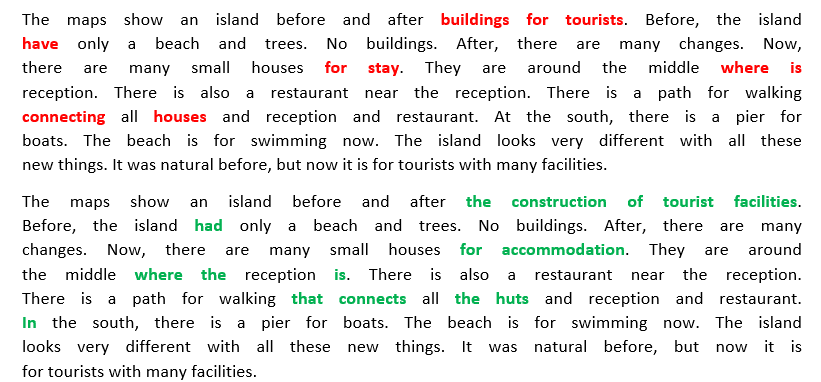
میبینیم که به خوبی از عهده این کار برمیآید و نکات مفید زیادی را هم ذکر میکند.
ادامه: حل نمونه سوال تصویری آیلتس: توصیف یک عکس به کمک chatGPT
خروجی پرامپت بالا
Sure, let’s review your summary and correct any errors. I’ll identify each mistake, explain why it is incorrect, provide the corrected version, and teach you how to fix each error with an example.
Original Summary with Corrections:
- Original: Before, the island had only a beach and trees. No buildings.
- Correction: Before, the island had only a beach and trees; there were no buildings.
- Explanation: “No buildings” is a fragment. Combine it with the previous sentence to make it complete.
- Example: Fragment: “She went to the store. Bought some milk.” Correct: “She went to the store and bought some milk.”
- Original: After, there are many changes.
- Correction: After the construction, there were many changes.
- Explanation: Specify what “after” refers to and maintain past tense consistency.
- Example: Incorrect: “After, she is happy.” Correct: “After the exam, she was happy.”
- Original: Now, there are many small houses for accommodation.
- Correction: Now, there are many small houses for accommodation.
- Explanation: This sentence is correct. No changes needed here.
- Example: N/A
- Original: They are around the middle where the reception is.
- Correction: They are around the middle of the island where the reception is.
- Explanation: Clarify that “the middle” refers to the middle of the island.
- Example: Incorrect: “Put it in the middle.” Correct: “Put it in the middle of the table.”
- Original: There is a path for walking that connects all the huts and reception and restaurant.
- Correction: There is a path for walking that connects all the huts, the reception, and the restaurant.
- Explanation: Use commas to separate items in a list for clarity.
- Example: Incorrect: “She bought apples and oranges and bananas.” Correct: “She bought apples, oranges, and bananas.”
- Original: In the south, there is a pier for boats.
- Correction: In the south, there is a pier for boats.
- Explanation: This sentence is correct. No changes needed here.
- Example: N/A
- Original: The beach is for swimming now.
- Correction: The beach is now for swimming.
- Explanation: Change the word order to make it more natural.
- Example: Incorrect: “He is happy always.” Correct: “He is always happy.”
- Original: The island looks very different with all these new things.
- Correction: The island looks very different with all these new facilities.
- Explanation: Use “facilities” instead of “things” to be more specific and formal.
- Example: Incorrect: “She has many things in her room.” Correct: “She has many items in her room.”
- Original: It was natural before, but now it is for tourists with many facilities.
- Correction: It was natural before, but now it is developed for tourists with many facilities.
- Explanation: Add “developed” to clarify the change in purpose.
- Example: Incorrect: “The area was empty before, but now it has shops.” Correct: “The area was empty before, but now it is developed with shops.”
Summary of Corrections:
- Combine fragments to create complete sentences.
- Specify what “after” refers to and use the correct tense.
- Use commas to separate items in a list.
- Adjust word order for natural phrasing.
- Use more specific and formal vocabulary.
If you have any more questions or need further clarification, feel free to ask!
در نهایت هم متن اصلاح شده را به ما میدهد:
The maps show an island before and after the construction of tourist facilities. Before, the island had only a beach and trees. No buildings. After, there are many changes. Now, there are many small houses for accommodation. They are around the middle where the reception is. There is also a restaurant near the reception. There is a path for walking that connects all the huts and reception and restaurant. In the south, there is a pier for boats. The beach is for swimming now. The island looks very different with all these new things. It was natural before, but now it is for tourists with many facilities.
تمرین
عکس یا pdf سوالات یک آزمون آیلتس را پیدا کنید و آن را به کمک chatGPT حل کنید.
من یک سوال را با توجه به پرامپت درس به chatGPT دادم و خودم هم برای آن رایتینگ نوشتم و دادم که اون رو تصحیح کنه این جوابchatGPT برای تصحیح متن من هست.
You’re on the right track, but there are a few areas where you can improve your response for clarity, accuracy, and cohesion. Here are my suggestions:
1. Clarify the introduction
The introduction should briefly mention the main trends or changes in the data without too much detail. It’s good that you’ve noted the increase in visitors, but make sure the transition between ideas is smooth.
Example:
“The table shows that the number of visitors to Ashdown Museum increased by 18,000, from 74,000 before refurbishment to 92,000 after. The two pie charts display the results of visitor satisfaction surveys during these two periods.”
2. Use more precise vocabulary
Try to use more formal and specific language where possible. For instance, “declined by more than half” is good, but you could use more precise expressions like “decreased significantly” or “dropped by more than half.”
Example:
“The number of dissatisfied visitors decreased significantly, dropping from 40% to 15%.”
3. Structure your ideas clearly
Ensure that each sentence supports the main points clearly. Avoid combining too many ideas into one sentence.
Example:
“The number of very satisfied visitors rose sharply, more than doubling from 15% to 35%.”
“Meanwhile, the percentage of very dissatisfied visitors fell dramatically to 5%.”
4. Improve cohesion between sentences
Link your ideas together more smoothly. For example, after talking about the increase in satisfaction, mention the absence of a significant change in the “satisfaction” of some visitors.
Example:
“While the percentage of satisfied visitors remained steady, the overall level of satisfaction improved considerably.”
5. Final thoughts / Conclusion
In IELTS Writing Task 1, it’s often good to briefly summarize the main trends or differences in a final sentence.
Example:
“In summary, the museum saw a clear improvement in both visitor numbers and satisfaction, particularly after refurbishment.”
Revised Answer Example:
“The table shows that the number of visitors to Ashdown Museum increased by 18,000, from 74,000 before refurbishment to 92,000 after. The two pie charts display the results of visitor satisfaction surveys during these two periods.
The percentage of dissatisfied visitors decreased significantly, dropping from 40% to 15%. Similarly, the number of very dissatisfied visitors fell dramatically, from 15% to just 5%. In contrast, the percentage of very satisfied visitors rose sharply, more than doubling from 15% to 35%. However, the proportion of satisfied visitors remained relatively stable at 40% before and after the refurbishment.
In summary, the museum experienced a notable rise in both visitor numbers and satisfaction, with significant improvements in the number of very satisfied and dissatisfied visitors.”
—
These changes help make your writing clearer and more formal, which is important for achieving a higher band score in IELTS Writing. Keep practicing!